


Translanguaging is a multifaceted concept. In 1994, Williams, a Welsh educator, informally referred to the term translanguaging as the process through which students receive information in one language and reproduce it in another one, thereby enhancing comprehension and proficiency in both languages (Τσοκαλίδου & Σκούρτου, 2020). However, the term was officially introduced in the sociolinguistic jargon in 2009 by Ofelia García, pointing to a broader sociolinguistic theory that is grounded in a holistic approach of bilingualism.
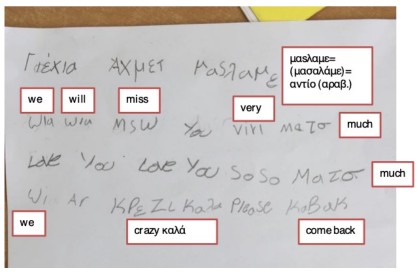
“Criezikala” classroom (Valai, Gana & Papadopoulou, 2025, p. 27)
Specifically, García (2011) defines translanguaging as a dynamic practice of bilingual communication in which the languages coexist and function as components of a single and integrated linguistic system of meaning and communication. Translingual practices (Canagarajah, 2018) are not necessarily confined to language resources, but can also be realized through other semiotic means, such as embodied linguistic expression and gestures (Capstick & Ateek, 2021). Li Wei (2011) conceptualizes translanguaging as a dynamic and multimodal act of learning and expression, proposing the concept of the “translanguaging space”, as a place where all available linguistic, cognitive, and cultural resources are employed complementarily by the speaker. Furthermore, Canagarajah (2018) urges us to move beyond pre-existing structuralist concepts and to regard translanguaging (he uses the term translingualism) as a set of practices in motion-expansive, situated and holistic-while emphasizing the spatial dimension of communication as spatiotemporal assemblages of semiotic resources that produce meaning.
This space allows speakers to transcend linguistic and cultural boundaries and to reconstruct their identities through language use (Τσοκαλίδου, 2018; Τσοκαλίδου & Σκούρτου, 2020). In more complex educational environments, such as the fluid translanguaging spaces that emerge in the context of literacy events (becoming literacy chronotopes in Kitsiou & Karantzola, 2022) and in reception centres for unaccompanied minors, speakers’ sociolinguistic repertoires are performed in unexpected ways. These sociolinguistic performances reveal and invert power relations between social actors, enact hybrid identities and express resistance to established “norms” (Kitsiou & Karantzola, 2022; Κίτσιου & Καραντζόλα, 2024). Within these “rhizomatic educational linguistic landscapes” (rhizomatic eduscapes, rhizo-eduscapes), creativity emerges as a key feature of the translanguaging space, reflecting the ability to choose between conformity and transgression of linguistic rules/ “norms”. In addition, critical thinking is encouraged, mediated through literacy practices and related to the use of cross-linguistic elements to understand cultural, social, political, and linguistic phenomena (Darvin, 2020).
The implementation of practices that subject bilingual and multilingual students to the exclusive learning of the dominant language of a given society (Toker & Olğun Baytaş, 2022) reflects monoglossic ideologies, often devaluing or marginalizing students’ other languages (García, 2009). In contrast, translanguaging as a pedagogical approach can facilitate learning among children and young people on multiple levels, offering cognitive, linguistic, emotional, and social benefits (Βαλαή, Γκανά & Παπαδοπούλου, 2025; Dougherty, 2021; Mammou et al., 2023; Rafi & Morgan, 2024; Toker & Olğun Baytaş, 2022). As an epistemological perspective, translanguaging can also challenge teachers’ traditional perceptions of language use, moving beyond the ideology of the standard language, towards a rhizomatic conceptualization of language education (Κίτσιου, 2024).
In conclusion, translanguaging appears to constitute a dynamic and inclusive approach that recognizes and values the “non-normative” sociolinguistic repertoires of students (Κίτσιου & Καραντζόλα, 2024), challenging monolingual norms across both educational and wider sociolinguistic contexts. Moreover, according to Tsokalidou and Skourtou (2020), translanguaging can serve as a culturally sustaining pedagogical approach, amplifying the voices of bilingual and multilingual students and promoting linguistic equality and inclusion, and ultimately sociolinguistic justice (Piller, 2016).
References
Rafi, A. S. M. & Morgan, A. M. (2024). Translanguaging as a transformative act in a reading classroom: Perspectives from a Bangladeshi private university. Journal of Language, Identity & Education, 23(4), 543–558.
Βαλαή, Φ., Γκανά, Ε., & Παπαδοπούλου, Μ. (2025). «Τάξη κρέζικαλα»: Η εμπειρία της διαγλωσσικότητας σε σχολική τάξη προσφύγων μαθητών/τριών. Στο Κίτσιου, Ρ., Κόμη, Ν. (Επιμ.) (2025). Πολυγραμματισμοί στην εκπαίδευση: Από τη θεωρία στην πράξη. Πρακτικά Συνεδρίου Τζαρτζάνεια 2018 (σσ. 19-30). (Τύρναβος, 23-24 Νοεμβρίου 2018). Δήμος Τυρνάβου.
Canagarajah, S. (2018). Translingual practice as spatial repertoires: Expanding the paradigm beyond structuralist orientations. Applied linguistics, 39(1), 31-54.
Capstick, T., & Ateek, M. (2021). Translanguaging spaces as safe space for psycho-social support in refugee settings in the Kurdistan region of Iraq. Journal of Multilingual and Multicultural Development, 45(2), 1–16.
Darvin, R. (2020). Creativity and criticality: Reimagining narratives through translanguaging and transmediation. Applied Linguistics Review, 11(4), 581–606.
Dougherty, J. (2021). Translanguaging in action: Pedagogy that elevates. ORTESOL Journal, 38, 19–32.
García, O. (2011). Bilingual education in the 21st century: A global perspective. John Wiley & Sons.
Κίτσιου Ρ. (2024). Αξιοποιώντας το «ρίζωμα» στην κοινωνιογλωσσολογική και την εκπαιδευτική έρευνα. Παιδαγωγικά ρεύματα στο Αιγαίο, 13(1). https://doi.org/10.12681/revmata.37703
Kitsiou, R., & Karantzola, E. (2022). The becoming “literacy chronotope”: Mapping translanguaging among unaccompanied minors as a rhizome. International Journal of Learner Diversity & Identities, 29(1).
Κίτσιου, Ρ. & Καραντζόλα. E. (2024). Μια ριζωματική χαρτογραφία του διαγλωσσικού χώρου: Η περίπτωση μιας γίγνεσθαι-τάξη γλωσσικού γραμματισμού αραβόφωνων ασυνόδευτων ανήλικων προσφύγων. Σε Ε. Ιωαννίδου & Στ. Τσιπλάκου (Επιμ.), Proceedings of the 6th International Conference ‘Crossroads of Languages and Cultures’ (CLC6) Plurilingualism, Variation, Spaces of Literacy, (σσ. 242-258) (2-4 September 2021).
Mammou, P., Maligkoudi, Ch., & Gogonas, N. (2023). Enhancing L2 learning in a class of unaccompanied minor refugee students through translanguaging pedagogy. International Multilingual Research Journal, 17(2), 139–156.
Piller, I. (2016). Linguistic diversity and social justice: An introduction to applied sociolinguistics. Oxford University Press.
Toker, Ş., & Olğun Baytaş, M. (2022). Grappling with the transformative potential of translanguaging pedagogy in an elementary school with Syrian refugees in post-coup Turkey. International Multilingual Research Journal, 16(2), 148–162.
Tsokalidou, R. (2018) SiDaYes! Πέρα από τη διγλωσσία προς τη διαγλωσσικότητα/Beyond bilingualism to translanguaging. Gutenberg
Tsokalidou, R., & Skourtou, E. (2020). Translanguaging as a culturally sustaining pedagogical approach: Bi/multilingual educators’ perspectives. In A. Creese & A. Blackledge (Eds.), Inclusion, education and translanguaging (pp. 255–272).
Wei, L. (2011). Moment analysis and translanguaging space: Discursive construction of identities by multilingual Chinese youth in Britain. Journal of Pragmatics, 43(5), 1222–1235.
Wei, L. (2018). Translanguaging as a practical theory of language. Applied Linguistics, 39(1), 9–30.