

Rhizome: an introduction
A rhizome is a philosophical term introduced by G. Deleuze and F. Guattari in their work A Thousand Plateaus, a multifaceted text, in which every word and every meaning deconstructs any sense of certainty. To quote Deleuze and Guattari: it ‘deterritorializes’ it.
So, what is a rhizome?
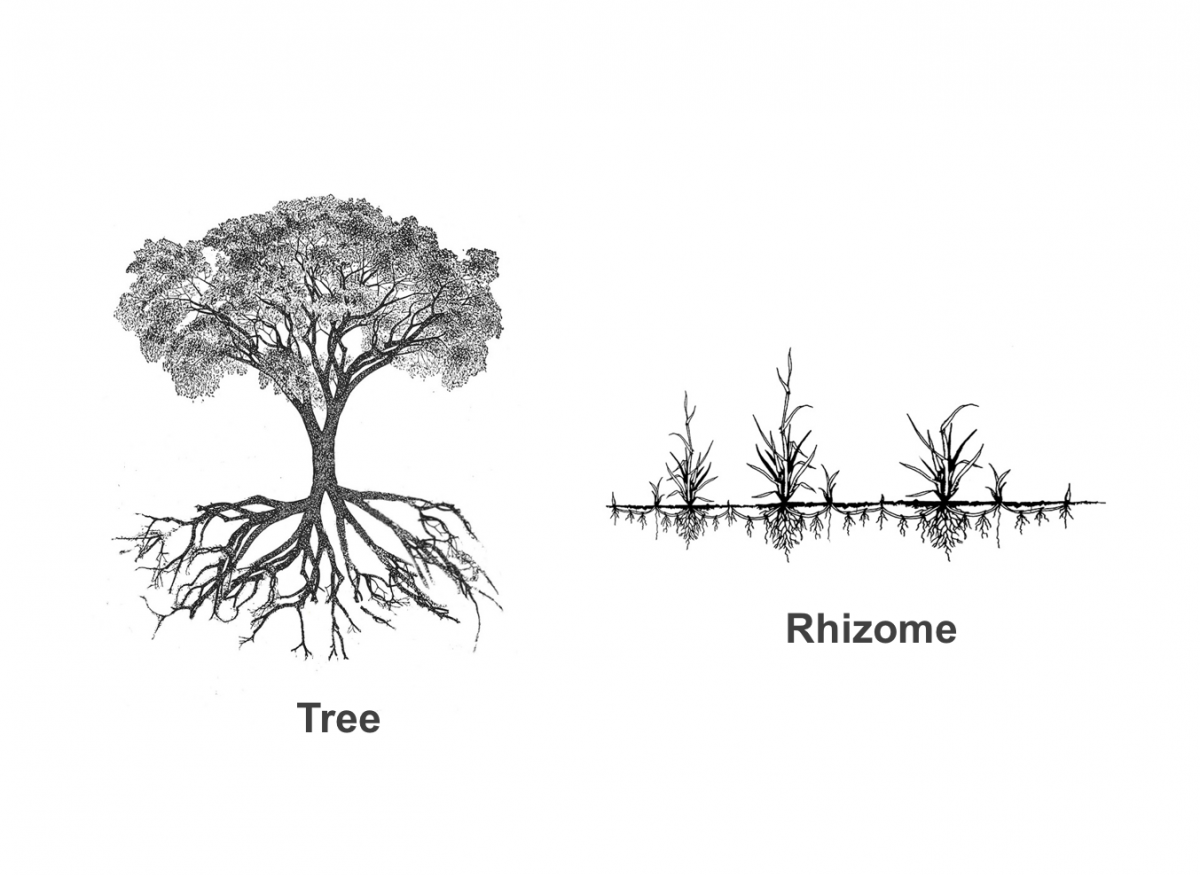
In Botany, a rhizome is a horizontal (or vertical) stem system that lives and moves through soil. The rhizome’s movement doesn’t follow any particular line and it doesn’t have a particular destination. Its stems are composed of appendage stems that escape from it, mapping their own path. Therefore, the rhizome is open to new possibilities, new territories. It is not bound to any plant or tree but has a life of its own.
Thus, in Deleuze and Guattari’s work, a rhizome is approached as a non-hierarchical system that has no center, consists of lines, and is always in the middle. It doesn’t have a beginning or an end but is read as a map in which every point can possibly be connected with any other, either homogeneous or heterogeneous, in an unpredictable way (Kitsiou, 2024, p.3).
The concept of the rhizome, as a network of multiplicities, contrasts with the
arborescent hierarchical structure based on linearity and duality. The rhizome can be broken down or interrupted at any point but it will continue its trajectory following a different line. The rhizome’s system cannot be destabilized by one single rupture.
According to Deleuze and Guattari, instead of trying to confine people to something that is easily measurable, we should ‘embrace’ them inside their chaos, in order that they can ‘embrace’ those possibilities of theirs that allow them to be human.
In Rhizo-Eduscapes project the concept of the rhizome is utilized in order to give visibility to everyone’s trajectories, embracing divergence, while promoting literacies that will produce a desire for learning, both to educators and students, thus mapping new lines of thinking. Through an intercultural perspective, and deeply inspired by sociolinguistic justice, we aim to cultivate a rhizomatic hope that will motivate individuals to unfold their abilities, while mapping their own lines of flight. Our goal is to re-territorialize our sociological and sociolinguistic imagination towards a flight into a culturally sensitive, linguistically and spatially just language education (Kitsiou,
2024).