

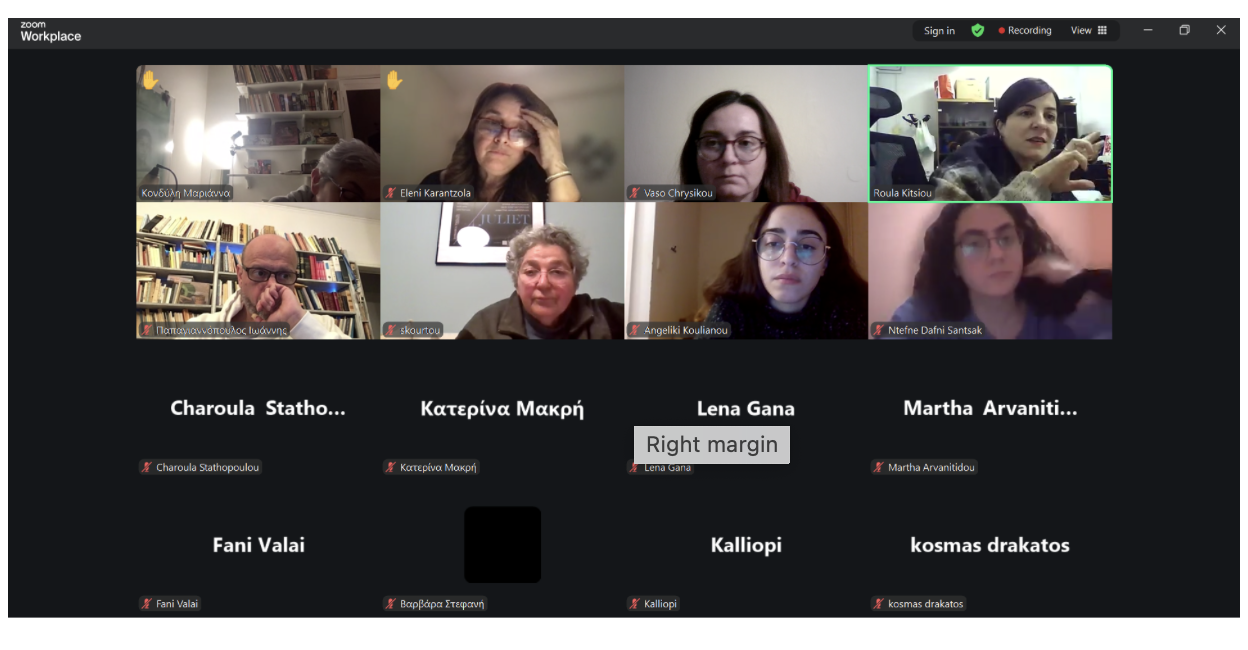
On January 28, 2026 (17:30–21:00), the 1st Free Form Meeting – Brainstorming & Reflecting was held. The meeting served as a space for collective reflection and exchange of ideas among the research sub-groups of the RHIZO-EDUSCAPES project, which presented selected findings emerging from the literature review, the analysis of educational materials, digital stories, and institutional texts.
The participating sub-groups were:
- Rhizo-Group 1: Educational Material Study and Critical Analysis Group for Refugees
- Rhizo-Group 2: Ethnomathematics Group
- Rhizo-Group 3: Research Ethics and Institutional Framework Group for Unaccompanied Minors
- Rhizo-Group 4: Educational Language Policy Group
- Rhizo-Group 5: Digital Storytelling Group
The aim of the meeting was to present the progress of the individual groups, to engage in critical discussion on key issues emerging from their work, and to establish shared directions for the next phases of the project.
The meeting was conducted in a hybrid format, with 22 members of the research team participating: 5 attended in person (Room G1, 3rd floor, Glavani 37, Volos, University of Thessaly) and 17 participated remotely via Zoom. During the meeting, six presentations were delivered, focusing on issues related to language and mathematics education for students with a refugee background.
The first presentation, by Fani Valai and Giorgos Kyriakopoulos, focused on rhizomatic approaches to learning, which conceptualize knowledge as a non-linear and dynamic network, highlighting the importance of multilingualism, students’ experiences, and sociocultural contexts.
In the second presentation, mathematical literacy was approached by Rhizo-Group 2 (Zafeira Balampanidou, Charoula Stathopoulou, and Vaso Chrysikou) as a sociocultural practice, emphasizing the need for teaching methods that draw on students’ linguistic and cultural repertoires.
The analysis of educational policies in Greece was presented by Marianna Kondyli and Eleni Karantzola. The presentation showed that the integration of students with a refugee background is primarily based on learning the Greek language, with limited recognition of multilingualism and tensions between inclusive approaches and assimilation-oriented practices.
Similarly, the fourth presentation, by Varvara Stefanidou and Martha Arvanitidou, focused on the mapping of educational materials related to the mathematics education of refugee minors in Greece. The findings suggest that, although the materials emphasize understanding and participation, make use of multimodality, and connect to everyday life, they also display limited use of translanguaging, superficial cultural inclusion, low adaptability, and a lack of digital support.
The mapping of the legislative and institutional framework for the mathematics education of refugee minors in Greece was presented by Zafeira Balampanidou and Vaso Chrysikou. The findings highlight a significant gap between the formal recognition of access to education and the actual achievement of educational equity in practice.
Finally, the sixth presentation, delivered by Katerina Makri, focused on digital storytelling and issues of representation and agency. It was presented as a complex field that functions simultaneously as an educational tool, a means of psychosocial support, and a way of enhancing public visibility, while raising important questions about agency, voice, and ethical representation.

The discussion that followed focused on key issues such as the use of terminology for unaccompanied minors, the accessibility and use of educational materials, the role of digital storytelling, and the relationship between language and mathematical literacy. At the same time, the need for a more holistic and cross-curricular approach to learning (across the curriculum) was highlighted, one that moves beyond the rigid separation of subject areas.
Through collective reflection, several important challenges were identified, including the limited availability of educational materials, difficulties in accessing them, and delays in the distribution of educational resources. These findings underscored the need for a more systematic mapping of existing materials, the development of accessible and applicable resources, and the strengthening of the link between theory and educational practice.
Overall, the meeting functioned as a key space for knowledge exchange and the development of shared directions, laying the groundwork for the continuation of the project through a more coherent, collaborative, and practice-oriented approach.
